
The scientific
fundamentals of our methods
DfACE builds on more than a decade of peer-reviewed research on circular economy systems conducted in industrial settings throughout Germany and Europe. This page documents the scientific foundations—the publications, concepts, and frameworks—that underpin every DfACE recommendation and make them externally verifiable.

A comprehensive overview of where value enters your product, moves through it, and exits it
The assessment begins with a bill of materials analysis—every component, subcomponent, and material input is recorded by weight, volume, recyclability, and current disposal route. This establishes the baseline. The energy flow analysis covers the entire production cycle: raw material extraction and transport, manufacturing processes, the product’s use phase, and disposal. Each phase is evaluated in terms of its energy intensity and its potential for closing material loops. The characterization of waste streams identifies every material leaving the system—whether as scrap, offcuts, rejects, packaging, or end-of-life products—and classifies each stream by material type, volume, current disposal route, and market recovery potential.
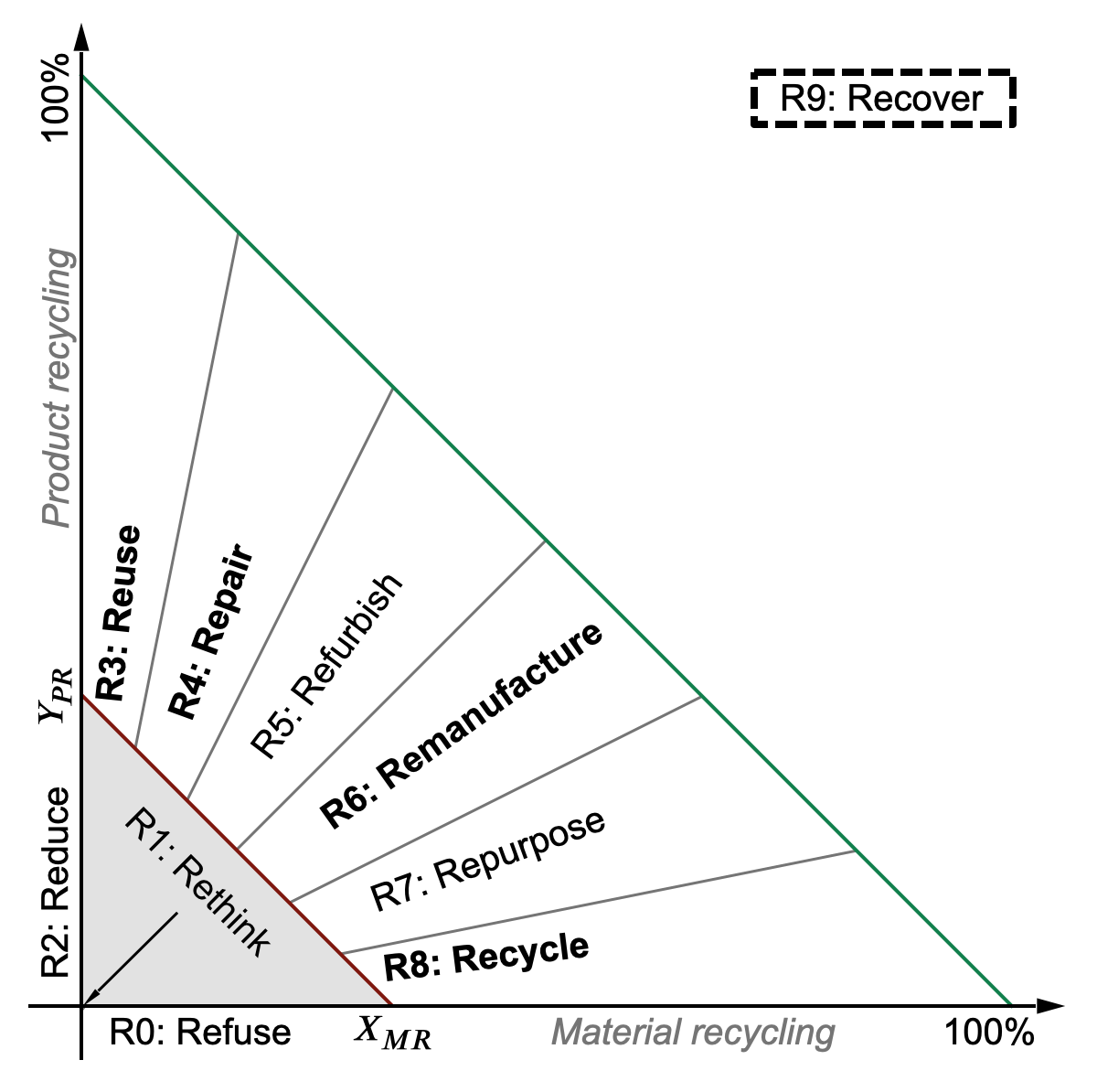
refers to the deliberate rejection of a product—that is, the decision not to develop, produce, or consume it. This approach is adopted when a product does not offer sufficient societal benefits within the circular economy. It may also be influenced by political, cultural, or regional factors.
involves fundamentally rethinking and redesigning a product that is currently not recyclable. This may involve building on existing designs or require a greater investment in development. This approach is particularly relevant for innovative products for which no suitable recycling processes yet exist.
aims to reduce material usage while maintaining the same functionality. Efficient use of materials is beneficial, but must not lead to premature component failure. At the same time, using less material can compromise the product’s future recyclability and cost-effectiveness.
refers to the repeated use of a product in its original form and for the same purpose. It is fully classified as product recycling and preserves the product’s integrity. It is clearly distinct from “repurposing,” in which the product’s purpose is changed.
refers to the repair of defective or worn components of a product. This requires that the design allow for easy access and that appropriate joining techniques be used to enable non-destructive disassembly. The approach also requires information, replacement parts, and organizational structures such as service offerings.
involves a comprehensive overhaul of a product to restore it to the best possible condition. During this process, not only defective components but also those that are potentially worn are inspected and, if necessary, replaced with identical parts. The process can also be performed by third-party providers and requires proper, non-destructive disassembly.
goes beyond refurbishment by replacing components with more powerful new versions. As a result, the product can be restored to a condition even better than when it was new. This approach requires a high degree of organizational integration and information flow, and is particularly well-suited for high-quality, complex products.
refers to using a product for a purpose other than its original intended use. In doing so, some of the material may be used inefficiently, as the product is not optimized for the new purpose. Nevertheless, this approach can make economic sense if it replaces the manufacture of a new product.
describes the dismantling of a product’s structure to recover materials. It is the fundamental end-of-life approach for all products and typically requires automated processes. Product design must therefore be tailored to the separability and process requirements of recycling technologies.
refers to the energy recovery of materials by extracting the energy they contain. After this process, both the product and the material are largely considered lost. This approach is used when other recycling options are not technically or economically feasible.
Supportive research
All of DfACE’s consulting services are based on published - including peer-reviewed - scientific papers.
The following publications form the core of our research.
Information as Key for Strategic Stakeholder Opportunities Within the Value Chain of an Advanced Circular Economy
Strategic Requirements-Based Product Design: A Tri-Tool Methodology For Advanced Circular Economy
Refine the circular economy by rethinking it -a holistic approach for the advanced circular economy
A Knowledge-based Product Design Assistance for the Advanced Circular Economy
Is it all about Information?
Circular sPrint Playbook
Der Einfluss der Fügetechnik auf die Konstruktion von Produkten für das Kreislaufwirtschaftssystem
A Knowledge-based Product Design Assistance for the Advanced Circular Economy
A Knowledge-based Product Design Assistance for the Advanced Circular Economy
Is it all about Information? The Role of the Information Gap between Stakeholders in the Context of the Circular Economy
Creation of a materials database for digital systematization in the design process for circular economy-compliant products
The Embedding of Circular Economy-Oriented Design Approaches into the Product Development Process
Economic Factors Influencing Sustainable Product Development
Turn your products into strategic assets
Circular economy strategies create measurable value across all areas of the business. Select an area to discover the specific benefits of DfACE at your level.